



ROHN 55SS040 40' foot 55G Self-Supporting Tower Complete Pre-engineered Kit
ROHN
 Made in the USA!
The ROHN 55SS040 40' foot 55G Self-Supporting Tower Kit comes Complete and Pre-engineered as Specified in the ROHN Catalog for Use at the Rated Height, Antenna load and Wind Speed indicated. This 55SS040 Kit is comprised of (4) 10' Tower Section(s), (1) Top Cap Plate, (1) 5' Base Section and Grounding Package(optional), less Foundation and Installation.
This Product Order Supplies the Following BOM (Less Foundation and Installation) in accordance for Use as a Self Supporting 40' Foot ROHN 55G Tower with EPA (Effective Projected Area) REV. F Ratings for 70, 80 or 90 MPH (No Ice) and REV. G Ratings for 90, 100 or 110 MPH (No Ice) 3-second Gust Wind Speeds. For more info click on the "More Info" or "Specification" Tabs above.
This Item Ships LTL Freight ONLY!
| INCLUDED MATERIALS WITH 55SS040 KIT | ||
|---|---|---|
| QUANTITY | PART NUMBER | DESCRIPTION |
| 1 | APL55G | Top Beacon Plate for 55G |
| 4 | 55G | 10' Tower Section |
| 4 | 55JBK | Bolt Kit for 55G Tower Section |
| 1 | SB55G | 5' Base Section |
| 1 | ACWS | Anti-Climb Warning Sign |
| 1 | ASSEMBLY GUIDE | Printed Specification/Assembly Guide |
| OPTIONAL ACCESSORIES FOR 55SS040 KIT | ||
| QUANTITY | PART NUMBER | DESCRIPTION |
| 2 | BGK2G | Tower Base Grounding Kit /includes: (1) 10' of #4 Copper Wire (1) 5/8" x 8' Copper Clad Ground Rod (1) 5/8" Ground Rod Clamp (1) 1 1/4" to 2" J-Clamp (For 55G/65G Section Tubular Rail) |

Self-Supporting Towers are limited in Height due to the nature of Antenna and Ice loads versus the Cantilever Nature Of Wind against them, offset by the weight of the Foundation and the cohesive of the soil to counter a Tower tip-over moment, as well as the strength of the tower members to withstand these Forces against them. ROHN Tower Kits are designed based on assumptions made regarding Windspeed, EPA (Antenna Load), Height, Standard Soil Conditions, Surrounding Environment and Duty. The Pre-packaged Kits contain the parts called for based on this Stock Design. The Stock Design of these Kits does not account for the Variations of Historic Windspeed, Number of Antenna(e) Loading at Specific Height(s), Soil Engineering recommendations, Adjacent Structures, Communications Purpose, or Geo-Political Rules, Laws and Codes That will be Applicable to Your Project. It is Recommended that you take the time to engage an local Engineer that has the expertise and available Information necessary to evaluate the Stock design for Applicability, and/or find the Tower Quote Data Sheet Form by clicking the link that appears on the Footer of this Page Below. *Per Rev G requirements, any structure greater than 10' foot requires a climber safety device.
 Download


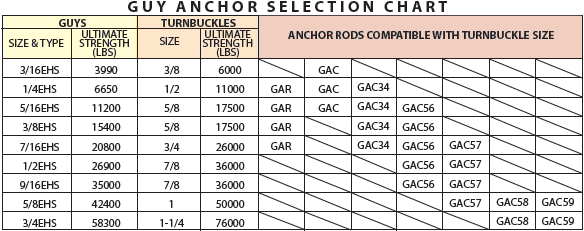
Tower Down Guy and Anchor Material included here are that which comprise the Kits specified by various dated and current ROHN catalogs. Reference the Pre-Engineered Kit Packages in the 25G 45G 55G 65G Buyer's Guides by Height and Wind load to build or supplement your ROHN G-Series Guyed Tower to current REV. G Specifications. New REV. G and Older REV. F Specification Sheets may be found in the various "ROHN Tower" links in the Footer section below and are made available only for study and reference. Any Departure or Questions of variance from the Pre-Engineered formats should be forwarded to and engaged by a Engineer qualified to make such determinations.
GUIDELINES FOR THE PREPARATION OF A GEOTECHNICAL REPORT
I. PURPOSE AND INTENT
a) The intended purpose of these guidelines is to assist the customer and/or owner to retain the services of a Geotechnical Engineer.
b) It is not ROHN´s purpose or intent to supersede the Geotechnical Engineer´s knowledge, judgement and/or experience. It is the Geotechnical Engineer´s responsibility to add or delete from these items, based on local site conditions and other factors.
c) Additional information is provided in ANSI/TIA-222-G Annex G "Geotechnical Investigations".
II. DISCLAIMER
a) ROHN will not accept any liability, either expressed or implied, for the use of, and omissions in, these guidelines.
III. EXPLORATORY BORINGS
a) Borings should be taken at tower legs for self-supporting towers and at the base and anchor points for guyed towers. For small self-supporting towers, two borings may suffice. For large self-supporting towers, one boring should be taken at each tower leg. A "small" self-supporting tower is assumed to have a face width less than 20 feet and a compression load less than 50 kips per leg. For pole structures, one boring may suffice.
b) The minimum boring depth should be 30 feet for pole structures, self-supporting towers and guyed tower bases. For guyed tower anchors, the minimum depth should be 15 feet. The actual depth of boring must be determined by the Geotechnical Engineer based on reactions, soil conditions and the type of foundation recommended.
c) If borings cannot be advanced to the desired depth, rock corings should be taken. Rock Quality Designation (RQD) values and compressive strengths should be determined.
IV. GEOTECHNICAL REPORT
a) The following properties, for each soil layer encountered, should be determined by field or laboratory testing and summarized in the geotechnical report:
1. Soil classification and elevations
2. Standard penetration values
3. Unconfined compression strength
4. Angle of internal friction
5. Cohesion
6. "In-Situ" soil density and moisture content
7. Rock quality designation (RQD) and percent rock sample recovered
8. Other properties unique to site conditions
b) The following items should be discussed in the geotechnical report:
1. Geological description of site
2. Observed and expected ground water conditions
3. Expected frost penetration depth
4. Corrosion potential of soil and corrosion protection recommendations
5. Site access and potential construction difficulties
6. Dewatering or site drainage requirements
7. Backfill material recommendations
8. Settlement considerations
9. Additional information to aid foundation designer
10. Recommended types of foundations
11. Design parameters for uplift, download and lateral load
12. Factor of safety considered when allowable vs. ultimate design parameters are provided
13. Recommended construction techniques and inspections