


3-Way Down Guy Wire Kit for 30 Foot Telescopic Antenna Mast H303WAYGUY
3 Star Inc
This H303WAYGUY Kit is a 3-way Down Guy Wire and Anchor package to secure your ROHN H30 and Easy Up TM30 Telescopic Push Up Antenna Masts at 3 levels. Guy wire gauge, Anchor size and Base Mount are Selectable Options.
(Mast is not included)
Works with the following Telescopic Masts:
ROHN- H30
Easy Up- EZ TM-30, EZ TM-30-U-95
Channel Master- 1630, 1830
| BILL OF MATERIALS: 30 Foot 3-Way Guy Wire & Anchor Kit | ||
|---|---|---|
| QUANTITY | PART NUMBER | DESCRIPTION |
| DOWN GUY WIRE SELECTION | ||
| 400 FT | (Includes) EZ 60 A | 6 Strand 20 Gauge Guy Wire |
| 400 FT | (Optional) EZ 60 | 6 Strand 20 Gauge Guy Wire Plastic Coated |
| 400 FT | (Optional) 618 | 6 Strand 18 Gauge Guy Wire |
| DOWN GUY ANCHOR SELECTION | ||
| 3 | (Includes) EZ 30 | 30” by 1/2” DIA Screw Anchor w/ 3” Helix |
| 3 | (Optional) EZ 48 | 48” by 5/8” DIA Screw Anchor w/ 6” Helix |
| CLAMPS/GRIPPLES INCLUDED | ||
| 9 | (Includes) 61820GRPL | Gripple for 20 and 18 Gauge Guy Wire used for Termination and Tension Adjustment of Guy Wire |
| 27 | (Includes) 1/8CCF | 1/8” Hot-Dipped Galvanized Cable Clamp |
| BASE PLATE MOUNT SELECTION | ||
| 1 | (Includes) EZ 32 | Standard Baseplate 9" Sq. Plate/No Collar Pier Pin Included |
| 1 | (Optional) EZ 32C | Heavy-Duty Baseplate 9” Sq. Plate/ 6" Collar -w- (1) Set Screw Accepts 2.25" OD Mast Pipe Pier Pin Included |
| 1 | (Optional) EZ TS-50 | Heavy-Duty Direct Ground Mount 9” Sq. Plate/18" Collar -w- (2) Set Screws Accepts 2.25" OD Mast Pipe 18.75" Welded Drive-in Rod (Stake) For Temporary Installations |
| TELESCOPIC MAST SELECTION | ||
| 1 | (Optional) EZ TM-30-U-95 | UPS Shippable Telescopic Mast Extends to 21.5 Feet ONLY |
General Information
This 3-Way Guy Wire and Anchor Kit is for 30 Foot Telescopic Push Up Antenna Masts.
Includes the accessories needed to SECURELY affix a Ground Based Telescopic Mast at the (3) levels of Down Guys from Guy Rings.
(Guy Rings supplied on Your Mast)
The standard Baseplate given is solely used for GROUND Mounted Installations.
There are other Mounts Designed for Roof Installations.
Wall Brackets may add to Structural integrity but do Not Replace the need for Down Guys.
Manufacturers recommend that masts heights of 10 feet and higher above the uppermost bracket be guyed for Addition Wind Load Support. Bonding/Grounding should be made by affixment to Mast. Consult NEC and Applicable Local Code for further guidance
PLEASE CONTACT A STRUCTURAL ENGINEER or PROFESSIONAL before installing Premise attached Structure.
As with all masts, Guy Wire Support and Grounding are CRITICAL to Antenna Survival.
Reference the Telescopic Mast ROHN Buyer’s Guide by Height to build or supplement your Telescopic Antenna Mast installation by clicking the Specification or More Info Tab above.
3-Way Down Guy Wire Kits are typically used for Ground-Based installations.
4-Way Down Guy Kits are typically used for Roof-Based installations.
Installations that are combination or hybrid and utilize substitution or additional structural components should be forwarded to and engaged by an Engineer qualified to make such decisions.
 Download

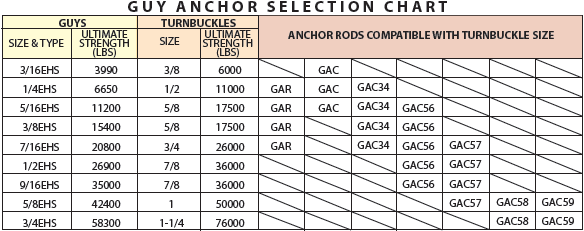
Tower Down Guy and Anchor Material included here are that which comprise the Kits specified by various dated and current ROHN catalogs. Reference the Pre-Engineered Kit Packages in the 25G 45G 55G 65G Buyer's Guides by Height and Wind load to build or supplement your ROHN G-Series Guyed Tower to current REV. G Specifications. New REV. G and Older REV. F Specification Sheets may be found in the various "ROHN Tower" links in the Footer section below and are made available only for study and reference. Any Departure or Questions of variance from the Pre-Engineered formats should be forwarded to and engaged by a Engineer qualified to make such determinations.
GUIDELINES FOR THE PREPARATION OF A GEOTECHNICAL REPORT
I. PURPOSE AND INTENT
a) The intended purpose of these guidelines is to assist the customer and/or owner to retain the services of a Geotechnical Engineer.
b) It is not ROHN´s purpose or intent to supersede the Geotechnical Engineer´s knowledge, judgement and/or experience. It is the Geotechnical Engineer´s responsibility to add or delete from these items, based on local site conditions and other factors.
c) Additional information is provided in ANSI/TIA-222-G Annex G "Geotechnical Investigations".
II. DISCLAIMER
a) ROHN will not accept any liability, either expressed or implied, for the use of, and omissions in, these guidelines.
III. EXPLORATORY BORINGS
a) Borings should be taken at tower legs for self-supporting towers and at the base and anchor points for guyed towers. For small self-supporting towers, two borings may suffice. For large self-supporting towers, one boring should be taken at each tower leg. A "small" self-supporting tower is assumed to have a face width less than 20 feet and a compression load less than 50 kips per leg. For pole structures, one boring may suffice.
b) The minimum boring depth should be 30 feet for pole structures, self-supporting towers and guyed tower bases. For guyed tower anchors, the minimum depth should be 15 feet. The actual depth of boring must be determined by the Geotechnical Engineer based on reactions, soil conditions and the type of foundation recommended.
c) If borings cannot be advanced to the desired depth, rock corings should be taken. Rock Quality Designation (RQD) values and compressive strengths should be determined.
IV. GEOTECHNICAL REPORT
a) The following properties, for each soil layer encountered, should be determined by field or laboratory testing and summarized in the geotechnical report:
1. Soil classification and elevations
2. Standard penetration values
3. Unconfined compression strength
4. Angle of internal friction
5. Cohesion
6. "In-Situ" soil density and moisture content
7. Rock quality designation (RQD) and percent rock sample recovered
8. Other properties unique to site conditions
b) The following items should be discussed in the geotechnical report:
1. Geological description of site
2. Observed and expected ground water conditions
3. Expected frost penetration depth
4. Corrosion potential of soil and corrosion protection recommendations
5. Site access and potential construction difficulties
6. Dewatering or site drainage requirements
7. Backfill material recommendations
8. Settlement considerations
9. Additional information to aid foundation designer
10. Recommended types of foundations
11. Design parameters for uplift, download and lateral load
12. Factor of safety considered when allowable vs. ultimate design parameters are provided
13. Recommended construction techniques and inspections