
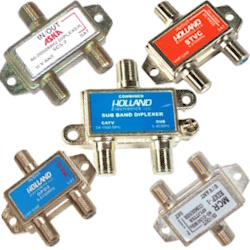
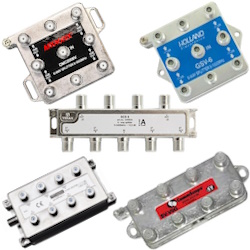
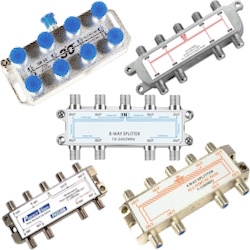
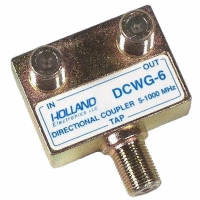
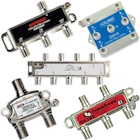
Coaxial Drop Cable Transmission & Distribution Passives
This Category of Passives provides the means to inter-connect all the "F" Connectorized RG Cables used for Transmission and Distribution lines in Your Commercial or Home System to Feed End-Use Subscriber Equipment like Receivers, TV's and DVR's. Each of these Components Introduces a Loss of Signal (Sometimes Non-linear) and Like the Cable Utilized, these Losses need to be Accounted and Compensated for.
Read More for Installation Notes.
Splitters
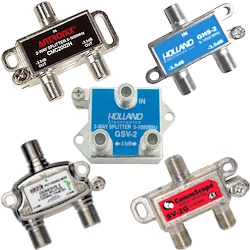
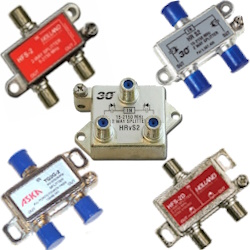
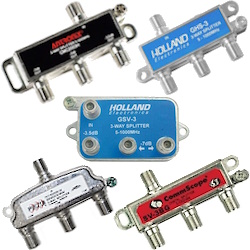
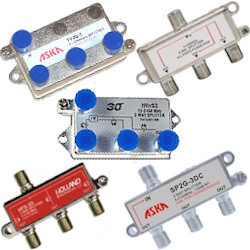
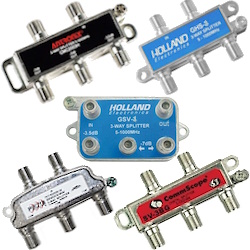
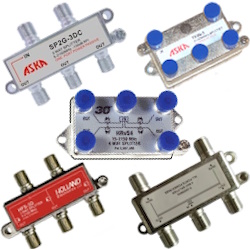
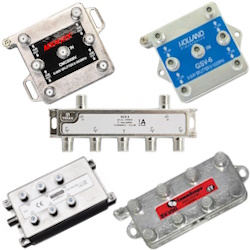
Splitters are obviously needed to turn one cable from your antenna into as many feeds as you need for Multiple TV locations and sets, but nothing is free... There is no such thing as a splitter without loss. If you split a signal into two, then half goes one way and half goes another. Actual loss is not linear when measured in dB, and if you had good signal before, one two-way splitter shouldn´t impact that, unless you were just above threshold. If you wish to connect more than two TV sets, you may want to consider the addition of an amplifier to your system to zero the loss out. The Most Common Interference and Picture Loss Problems are as a Result of Introducing Splitters to Feed more Outlets and not Compensating for the Losses!
"Splitters" can also be used as combiners equally as well, exhibiting the same loss over frequency characteristics. If you desired to get stations from two or more different directions, you could install and aim two or even three antennas and combine the outputs back onto one cable, amplify and distribute the signals around the house like a Mini-Cable TV System!
Satellite TV Passives
Here you can find passives for use between the satellite dish and your receiver(s) that will complete your system and bring the parts and pieces of the whole installation together. When you add a second source of Signal to Feed thru your System such as off-Air TV antennas, Cable TV or a Broadband Internet connection, these components now become a Necessity! With the Right Selection of Parts, You can route, Mix and Distribute almost Any Combination of Wide-band Signals to the location you need them. Then, once there, you can separate and Provide the Inputs necessary for the Appropriate End-Use Equipment.
Signal Gains & Losses
Do not forget to account for gains and/or losses throughout your system of distribution, starting with the Signal Origin (LNB) and Terminating at the Receivers. The Starting Signal Level and Amplifier Gains should Equal the Line (Drop) and Passive Losses in addition to the proper Signal Levels above Receiver Input Threshold to Optimize Signal to Noise Ratios, Picture Quality and Performance.
Splitting a Satellite Signal
When Splitting the High Frequencies of Satellite TV Services to feed multiple Receivers, the Loss associated with the splitter may need to be compensated for with the use of an In-Line Satellite Drop Amplifier specific to this purpose and Frequency Range. Consider the need and review the "Satellite TV Amplifier" category for selection.
Sending Voltage Back
There is also the issue of supplying Voltage back to the LNB(F), this may be addressed more resolutely with the installation of a Power Supply and Power Inserter made just for this purpose. Review the "DC Power Inserter" category for these items.
Signal Diplexers
Most Signal Diplexer Examples Use Scenarios requiring two (2) of these devices to properly Mix and then Un-Mix the signal feeds to the Appropriate Devices in question.
Grounding Your System
Commensurate with Satellite TV Antenna and Splitter Installation, you want to Ground your Coaxial Cable System Outside before bringing the RG-6 Cable Inside. This way, Lightning Strikes and Power Surges have an opportunity to arrest before reaching your TV and Entertainment Electronics. The Integral Grounding Block designed onto most Outdoor Use Compatible RF Signal Splitter we sell will effectively convey this unwanted Electrical Energy to a Ground Rod via a Copper Ground Wire that you Install (not included). Also Available are Dual F Port Grounding Blocks specific for this purpose and Frequency rang.
Consult your Local Building Code and NEC for guidance to Properly Grounding your HD TV Antenna, Satellite TV, Cable TV, WI-FI, Wireless Internet, Business Band, CB or Amateur Radio Antenna Installation.



- ROHN TOWERS & MASTS Sections, Mounts & Parts
- ALUMINUM TOWER KITS Sections, Mounts & Parts
- TOWER SAFETY SYSTEMS Climbing, Lighting & Paint
- STEEL STRUT CHANNEL SLOTTED & GALVANIZED
- HDG, GALVANIZED PIPE and ALUMINUM TUBING
- EHS STRAND & GUY WIRE Grips, Turnbuckle, Anchor
- HD THIMBLES SHACKLES CLAMPS for Strand & Guy
- ROHN ANTENNA TOWER MOUNT ASSEMBLIES
- HEAVY DUTY ANTENNA WALL MOUNT Assemblies
- NON-PENETRATING ROOF ANTENNA MAST MOUNTS
- PARALLEL PIPE to PIPE & POLE MOUNT CLAMP SETS
- Pipe to Pipe Perpendicular CROSSOVER CLAMP SETS
- Galvanized V-Clamp Halves & Alligator Jaw Pipe Clamps
- EYE Bolts J Bolts Clamps Pier Pins Threaded Rods
- SQUARE/ ROUND U-BOLTS HDG & PRE-GALVANIZED
- BOLTS NUTS WASHERS and TOWER JOINT KITS
- TELESCOPIC MASTS and ANTENNA MAST POLES
- ANTENNA MAST MOUNTS for WALL, ROOF, CHIMNEY
- ANTENNA ROOF MOUNTS PEAK PITCH EAVE GABLE
- GROUNDING & BONDING Wire Blocks Clamps Rods
-
BROADBAND TV ANTENNA SATELLITE TELCO INSTALL
- RG-6 Coaxial Cables
- RG-11 Coaxial Cables
- CAT 3 Bulk Phone Cable
- Coaxial Connectors & Adaptors
- In-line Drop Cable TV Signal Attenuator Pads
- In-line Drop Cable TV RF Bandpass Filters
-
SATELLITE/ BROADBAND & TV ANTENNA SPLITTERS
- 2-WAY Broadband CABLE TV & ANTENNA SPLITTERS
- 2-WAY Wideband DISH and SATELLITE TV SPLITTERS
- 3-WAY Broadband CABLE TV & ANTENNA SPLITTERS
- 3-WAY Wideband DISH and SATELLITE TV SPLITTERS
- 4-WAY Broadband CABLE TV & ANTENNA SPLITTERS
- 4-WAY Wideband DISH and SATELLITE TV SPLITTERS
- 6-WAY Broadband CABLE TV & ANTENNA SPLITTERS
- SATELLITE TV DIPLEXER COMBINER SEPARATOR
- 8-WAY Broadband CABLE TV & ANTENNA SPLITTERS
- 8-WAY Wideband DISH and SATELLITE TV SPLITTERS
- IN-WALL Coax CATV MATV Splitter for Hotel Apartment
- Amplifiers
- Multimedia Enclosures Racks Mounts & Carts
- Broadband OSP Cable Equipment Hardware
- Wholesale and Excess Inventory Closeouts