


Harger CPC1.5/2 Clamp for Grounding ROHN 65G 55G Tower and Base Sections
ROHN
 Made in the USA!
The CPC1.5/2 Clamp is for Solid and Stranded Copper Wire and Stranded Wire Rope Grounding Connections to the 55G and 65G Main Tower Sections and Fixed Rigid Bases by means of affixing these 1.5 to 2.00 inch range Clamps around at any one of the (3) Tubular Rail (1.25" - 2.4" OD actual range) components at the lowest visible point possible above grade and in closest proximity to the Ground intended for use as to shorten the wire distance between as much as possible. The Lug also mates the connection to Solid/Stranded Copper or 7/16 6x25 EIP IWRC RRL Wire Rope as supplied in the BGK3GGX REV. G Grounding Kits (not included).
Harger CPC Pipe Ground Clamps compare to Burndy GAR
Made to connect to any of the three Leg Rail components of a 55G and 65G Main Tower or Fixed Rigid Base Sections in a Typical Tower Installation as these Tubes are within the nominal OD range above. This Clamp will also connect the Solid or Stranded Copper Ground Wire lead to the Ground Rod on the other end, completing your Grounding (Lightning Protection) System. Typically, 3 of these Clamps are used as most Systems will dictate that a separate Ground Connection be made to all three Tower Rail Tubes.
 Download
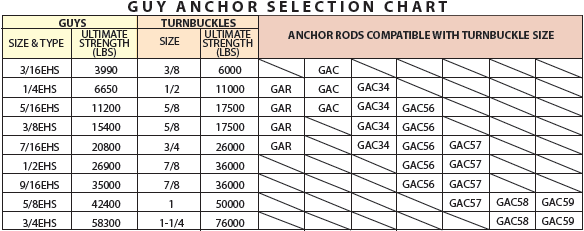
Tower Down Guy and Anchor Material included here are that which comprise the Kits specified by various dated and current ROHN catalogs. Reference the Pre-Engineered Kit Packages in the 25G 45G 55G 65G Buyer's Guides by Height and Wind load to build or supplement your ROHN G-Series Guyed Tower to current REV. G Specifications. New REV. G and Older REV. F Specification Sheets may be found in the various "ROHN Tower" links in the Footer section below and are made available only for study and reference. Any Departure or Questions of variance from the Pre-Engineered formats should be forwarded to and engaged by a Engineer qualified to make such determinations.
GUIDELINES FOR THE PREPARATION OF A GEOTECHNICAL REPORT
I. PURPOSE AND INTENT
a) The intended purpose of these guidelines is to assist the customer and/or owner to retain the services of a Geotechnical Engineer.
b) It is not ROHN´s purpose or intent to supersede the Geotechnical Engineer´s knowledge, judgement and/or experience. It is the Geotechnical Engineer´s responsibility to add or delete from these items, based on local site conditions and other factors.
c) Additional information is provided in ANSI/TIA-222-G Annex G "Geotechnical Investigations".
II. DISCLAIMER
a) ROHN will not accept any liability, either expressed or implied, for the use of, and omissions in, these guidelines.
III. EXPLORATORY BORINGS
a) Borings should be taken at tower legs for self-supporting towers and at the base and anchor points for guyed towers. For small self-supporting towers, two borings may suffice. For large self-supporting towers, one boring should be taken at each tower leg. A "small" self-supporting tower is assumed to have a face width less than 20 feet and a compression load less than 50 kips per leg. For pole structures, one boring may suffice.
b) The minimum boring depth should be 30 feet for pole structures, self-supporting towers and guyed tower bases. For guyed tower anchors, the minimum depth should be 15 feet. The actual depth of boring must be determined by the Geotechnical Engineer based on reactions, soil conditions and the type of foundation recommended.
c) If borings cannot be advanced to the desired depth, rock corings should be taken. Rock Quality Designation (RQD) values and compressive strengths should be determined.
IV. GEOTECHNICAL REPORT
a) The following properties, for each soil layer encountered, should be determined by field or laboratory testing and summarized in the geotechnical report:
1. Soil classification and elevations
2. Standard penetration values
3. Unconfined compression strength
4. Angle of internal friction
5. Cohesion
6. "In-Situ" soil density and moisture content
7. Rock quality designation (RQD) and percent rock sample recovered
8. Other properties unique to site conditions
b) The following items should be discussed in the geotechnical report:
1. Geological description of site
2. Observed and expected ground water conditions
3. Expected frost penetration depth
4. Corrosion potential of soil and corrosion protection recommendations
5. Site access and potential construction difficulties
6. Dewatering or site drainage requirements
7. Backfill material recommendations
8. Settlement considerations
9. Additional information to aid foundation designer
10. Recommended types of foundations
11. Design parameters for uplift, download and lateral load
12. Factor of safety considered when allowable vs. ultimate design parameters are provided
13. Recommended construction techniques and inspections