

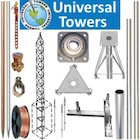
Universal Towers Engineered Tower Kit Packages
Universal Towers Aluminum Tower Packaged kits are Pre-engineered antenna support systems using selected straight and tapered 10 ft. sections for a Freestanding Tower with a stated antenna wind load rating at a specified height. Large Antenna Load EPAs with Specific Weight and Height Placement should be run past Universal's Engineering Dept.
Please contact us or send us an email to support@starinc.com if you have any questions or need help in determining the best options for your tower needs. Universal Towers also provides Customer Support Services including Engineering and Custom Designs for Specific Applications.
Read More for Installation Overview Notes.
Universal's tapered towers feature rugged, heavy-wall aluminum tubing legs and welded S-bracing made of high quality aluminum minimize space and weight while maintaining excellent strength and high wind load ratings in a completely freestanding structure that is durable and reliable, yet light weight. Each welded truss section is fully assembled, finished and supplied with the required hardware for easy installation. These freestanding towers can raise large antennas into the open air easily with a concrete anchored hinged base. Select your Universal Tower package by wind load rating to a desired height; Standard Duty or Heavy Duty Universal Tower Package to ensure the best reliability for your TV Antenna , WIFI , Radio, Wireless Internet, Cellular or Internet Gateway, and Starlink antennas that fit your needs. (Caution: Freestanding Towers will sway slightly under wind load and are therefore not recommended for High Focal Point Antennas or Camera Systems). Universal's Freestanding Aluminum Towers typically have no need for Down Guys in Ground Mount Based Installations but will likely require them in a Flat Roof Mount Installation Scenario.
Before ordering your Pre-engineered Tower Solution, there are a few things that need to be determined.
First, the projected area of the antenna that you intend to mount (this figure is often located in the literature that comes with the antenna or on the antenna manufacturers website). Standard TV antennas are about two square feet in area; 6 and 10 meter beams and large TV antennas utilize 5 square feet; 20 and 40 meter beams utilize 9 square feet; large 20 and 40 meter beams or multiple antenna arrays utilize 18, 22 and 26 Square feet.
Second, determine is any accessories are being used. Note that when using a rotator, add 1 square foot plus an additional square foot for mast to whichever size antenna you intend to use.
Third, choose the right Universal Tower for your application. Our model numbers are simply the wind load rating followed by the tower height. For example, if your antenna calculation resulted in a tower designed for 5 square feet of wind load and you wish to be 50 foot tall, the model number you would choose would be a 5-50.
How to install a Universal Towers Foundation and Base
When installing one of our bases it is important to make sure you have the base submerged in the concrete to the proper depth. When digging the hole we have specific depths depending on the base you are installing for instance the B-18 base requires a hole to be 3’ x 3’ x 4’ deep. This being said you will want to measure from the bottom of the base leg up 4’ and put a line with a marker and that is how far the concrete should be poured to. If the base has a 5’ deep hole then you will want to measure up 5’ on the base. This is also true if the base requires a 6’ deep hole then you would measure up 6’. It is important to understand that wherever there is a weld on the base it should not be seen above the concrete as the concrete helps to support the base from long term metal fatigue.
Concrete Specification
The minimum strength concrete should be of 3000 psi. This is a mass foundation, so its main purpose is to act as a counter weight against tower tip-over moments due to Wind load and Seismic Events.
Preparation of the Base Legs
We recommend filling the base leg openings that are in the concrete with play sand. You should fill it up just about an inch shy of the top and then cap it with silicone caulk. This should reduce the likelihood of any water accumulating in the tube.



- ROHN TOWERS & MASTS Sections, Mounts & Parts
- ALUMINUM TOWER KITS Sections, Mounts & Parts
- TOWER SAFETY SYSTEMS Climbing, Lighting & Paint
- STEEL STRUT CHANNEL SLOTTED & GALVANIZED
- HDG, GALVANIZED PIPE and ALUMINUM TUBING
- EHS STRAND & GUY WIRE Grips, Turnbuckle, Anchor
- HD THIMBLES SHACKLES CLAMPS for Strand & Guy
- ROHN ANTENNA TOWER MOUNT ASSEMBLIES
- HEAVY DUTY ANTENNA WALL MOUNT Assemblies
- NON-PENETRATING ROOF ANTENNA MAST MOUNTS
- PARALLEL PIPE to PIPE & POLE MOUNT CLAMP SETS
- Pipe to Pipe Perpendicular CROSSOVER CLAMP SETS
- Galvanized V-Clamp Halves & Alligator Jaw Pipe Clamps
- EYE Bolts J Bolts Clamps Pier Pins Threaded Rods
- SQUARE/ ROUND U-BOLTS HDG & PRE-GALVANIZED
- BOLTS NUTS WASHERS and TOWER JOINT KITS
- TELESCOPIC MASTS and ANTENNA MAST POLES
- ANTENNA MAST MOUNTS for WALL, ROOF, CHIMNEY
- ANTENNA ROOF MOUNTS PEAK PITCH EAVE GABLE
- GROUNDING & BONDING Wire Blocks Clamps Rods
- BROADBAND TV ANTENNA SATELLITE TELCO INSTALL
- Multimedia Enclosures Racks Mounts & Carts
- Broadband OSP Cable Equipment Hardware
- Wholesale and Excess Inventory Closeouts