



ROHN 25SS010 10' foot 25G Self-Supporting Tower Complete Pre-engineered Kit
ROHN
 Made in the USA!
The ROHN 25SS010 10' foot 25G Self-Supporting Tower Kit comes Complete and Pre-engineered as Specified in the ROHN Catalog for Use at the Rated Height, Antenna load and Wind Speed indicated. This 25SS010 Kit is comprised of (1) Tower Top Cap Section, (1) 5' Base Section and Grounding Package (optional), less Foundation and Installation.
This Product Order Supplies the Following BOM (Less Foundation and Installation) in accordance for Use as a Self Supporting 10 Foot ROHN 25G Tower with EPA (Effective Projected Area) REV. F Ratings for 70, 80 or 90 MPH (No Ice) and REV. G Ratings for 90, 100 or 110 MPH (No Ice) 3-second Gust Wind Speeds. For more info click on the "More Info" or "Specification" Tabs above.
This Item Ships LTL Freight ONLY!
| INCLUDED MATERIALS WITH 25SS010 KIT | ||
|---|---|---|
| QUANTITY | PART NUMBER | DESCRIPTION |
| 1 | 25AG2 | Top Cap Tower Section |
| 1 | 25AJBK | Bolt Kit for 25G Top Section |
| 1 | SB25G5 | 5' Base Section |
| 1 | ACWS | Anti-Climb Warning Sign |
| OPTIONAL ACCESSORIES FOR 25SS010 KIT | ||
| QUANTITY | PART NUMBER | DESCRIPTION |
| 2 | BGK3G | Tower Base Grounding Kit /includes: (1) 10' of #4 Copper Wire (1) 5/8" x 8' Copper Clad Ground Rod (1) 5/8" Ground Rod Clamp (1) 5/16" x 2 3/8" Grade 5 HDG Bolt (1) 5/16" Hex HDG Nut (1) Hy-Lug YA4C-L4 Compression Terminal Lug |
The 25AG2* Top Cap Tower Section is the Default Standard
Top Section for the 25G Series Tower Kits.
We Offer the following Substitutions when Ordering Our Kits:
| OPTIONAL TOP CAPS FOR 25SS010 KIT | |||
|---|---|---|---|
| PART NUMBER | DESCRIPTION | HEIGHT | O.D. |
| 25AG | Top Cap | 9' | 2" |
| 25AG1 | Top Cap | 9' - 3" | 1.66" |
| 25AG2* | Top Cap | 9' - 9" | 2.25" |
| 25AG3 | Top Cap | 9' - 3 1/2" | 2.25" |
| 25AG4 | Flat Plate Top Cap for Thrust Bearing |
8' - 3/16" | Pre-drilled FLAT |
| 25AG5 | Top Cap | 8' - 1/2" | 2.75" |
This 25G Tower is to be used in a Self-Supporting Configuration according to Use and Foundation Specifications.
This Height Configuration relies on a SB25G5 Embedded in a Concrete Foundation Specified by Engineering. As a Free-Standing, Self-Supporting Structure, a 70, 80 or 90 MPH rated 25G Tower can rise to a maximum of 40 feet.
Visit our Knowledge Base for more ROHN 25G Tower Configurations, Foundation and Grounding Detail Information.
Self-Supporting Towers are limited in Height due to the nature of Antenna and Ice loads versus the Cantilever Nature Of Wind against them, offset by the weight of the Foundation and the cohesion of the soil to counter Tower tipover, as well as the strength of the tower members to withstand these Forces against them. ROHN Tower Kits are designed based on assumptions made regarding Windspeed, EPA (Antenna Load), Height, Standard Soil Conditions, Surrounding Environment and Duty. The Pre-packaged Kits contain the parts called for based on this Stock Design. The Stock Design of these Kits does not account for the Variations of Historic Windspeed, Number of Antenna(e) Loading at Specific Height(s), Soil Engineering recommendations, Adjacent Structures, Communications Purpose, or Geo-Political Rules, Laws and Codes That will be Applicable to Your Project. It is Recommended that you take the time to engage an local Engineer that has the expertise and available Information necessary to evaluate the ROHN Catalog Pre-engineered design for Applicability, and/or find the Tower Quote Data Sheet Form by clicking the link that appears on the Footer of this Page Below. *Per Rev G requirements, any structure greater than 10' foot requires a climber safety device.


The ROHN 45GSR Series Multipurpose Tower
The 65G is designed to provide excellent rigidity and strength in applications up to 500´. This high strength design covers a wide variety of communication uses. The 65G is completely prefabricate in welded sections, allowing for quick and convenient installation.
Tower & Foundation Installation
Tower and foundation installations should be performed by qualified and experienced personnel using construction drawings. This document is to serve as a guide for sizing and buying the 25G tower. All types of antenna installations should be thoroughly inspected by qualified personnel and re-marked with appropriate danger and anti-climb labels at least twice a year to ensure safety and proper performance.
Wind Loading
Wind Loading, Antenna Loading and Wind Survivability ratings vs. Height Documentation Provided by ROHN is available here as a Resource, but is by no means complete by itself or a substitution; for Engineering Conducted Specific to your Application. Contact Us with any Questions you may have regarding Use prior to Purchase. All Information regarding the ROHN 25G Tower line, Parts and Accessories is as accurate and complete as we can possibly provide given that this Resource Offering is subject to change without Notice and is beyond Our Control.
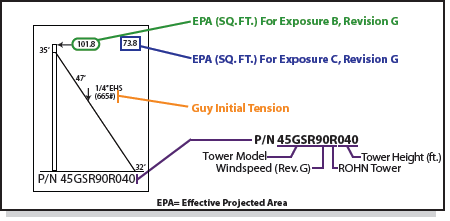
DESIGN NOTES:
1. Tower designs are in accordance with ANSI/TIA-222-F-1996 and ANSI/TIA-222-G-2005, Class I Structures, Topographical Category 1.
2. Design assumes towers are installed on level ground. Lower EPA values will apply for roof mounted towers or for sites located on unusual terrain.
3. Designs assume two 7/8" diameter lines on each tower face.
4. Anchor radius is from tower base to intersection of anchor rod with ground.
5. Tower designs and guy chord lengths shown are based on level ground. Initial tensions for guys in pounds at 60º Fahrenheit are shown in ( ).
6. Antenna and mounts are assumed symmetrically placed at the tower top.
PARTS LIST NOTES:
1. Items listed are required for complete (ground) guyed towers.
2. Base and anchor foundations listed refer to standard foundation designations.
3. Guys provided with each standard tower are based on level ground conditions with an additional 6% length.
4. Rev G anchor grounding (AGK1GGX) and base grounding (BGK3GGX) are included with the tower material.
5. Assembly Drawings and a safety package (P/N: ACWS) are included with each tower.
6. Parts lists are subject to change based on availability or revised design criteria.

This Buyers Guide will answer many questions you may have on this Product Line.
ROHN Tower series is the Workhorse of America's Large and Small Communications needs; from Governments, Institutions, Space Program, Olympics, TV AM FM Broadcast, Terrestrial Microwave to Business-Band Radio, HAM Radio Operators, to Off-Air Antenna TV and DTV Reception in Fringe areas outside the Suburban Broadcast Area. ROHN fabricates their towers from the highest quality steel. They maintain mill certification on the raw materials they receive to verify the material composition of each structural member. With a focus on quality, their fabrication facility has been awarded Certification by the American Institute of Steel Construction and the Canadian Welding Bureau. They have also been approved by the City of Los Angeles, CA and Clark County, NV as a certified fabricator. They are confident that their facility and staff can produce superior grade towers and poles that will meet your standards and weather the test of time. ROHN Towers, Accessories and their Construction/Assembly Assistance are also available via 3StarInc.com... Call 877-660-0974 at anytime for assistance.
GUIDELINES FOR THE PREPARATION OF A GEOTECHNICAL REPORT
I. PURPOSE AND INTENT
a) The intended purpose of these guidelines is to assist the customer and/or owner to retain the services of a Geotechnical Engineer.
b) It is not ROHN´s purpose or intent to supersede the Geotechnical Engineer´s knowledge, judgement and/or experience. It is the Geotechnical Engineer´s responsibility to add or delete from these items, based on local site conditions and other factors.
c) Additional information is provided in ANSI/TIA-222-G Annex G "Geotechnical Investigations".
II. DISCLAIMER
a) ROHN will not accept any liability, either expressed or implied, for the use of, and omissions in, these guidelines.
III. EXPLORATORY BORINGS
a) Borings should be taken at tower legs for self-supporting towers and at the base and anchor points for guyed towers. For small self-supporting towers, two borings may suffice. For large self-supporting towers, one boring should be taken at each tower leg. A "small" self-supporting tower is assumed to have a face width less than 20 feet and a compression load less than 50 kips per leg. For pole structures, one boring may suffice.
b) The minimum boring depth should be 30 feet for pole structures, self-supporting towers and guyed tower bases. For guyed tower anchors, the minimum depth should be 15 feet. The actual depth of boring must be determined by the Geotechnical Engineer based on reactions, soil conditions and the type of foundation recommended.
c) If borings cannot be advanced to the desired depth, rock corings should be taken. Rock Quality Designation (RQD) values and compressive strengths should be determined.
IV. GEOTECHNICAL REPORT
a) The following properties, for each soil layer encountered, should be determined by field or laboratory testing and summarized in the geotechnical report:
1. Soil classification and elevations
2. Standard penetration values
3. Unconfined compression strength
4. Angle of internal friction
5. Cohesion
6. "In-Situ" soil density and moisture content
7. Rock quality designation (RQD) and percent rock sample recovered
8. Other properties unique to site conditions
b) The following items should be discussed in the geotechnical report:
1. Geological description of site
2. Observed and expected ground water conditions
3. Expected frost penetration depth
4. Corrosion potential of soil and corrosion protection recommendations
5. Site access and potential construction difficulties
6. Dewatering or site drainage requirements
7. Backfill material recommendations
8. Settlement considerations
9. Additional information to aid foundation designer
10. Recommended types of foundations
11. Design parameters for uplift, download and lateral load
12. Factor of safety considered when allowable vs. ultimate design parameters are provided
13. Recommended construction techniques and inspections